Fitness Center and Gym Roofing in Provo, UT
Commercial Roofing • Commercial Project Types • Provo,
Gym and Fitness Center Roofs Over Large Open-Volume Spaces
Fitness centers and gyms scattered through Provo, Orem, and the retail corridors along University Parkway carry a roof problem that's more about physics than most commercial buildings realize: a large open volume with heavy moisture load from sweat, showers, and pool areas sitting under a single wide roof deck. We approach these buildings differently than a standard retail or office roof because of that moisture and volume combination.
Condensation Is the Recurring Problem, Not Only Leaks
A gym generates far more interior humidity than a typical commercial building, between cardio floors full of sweating members, locker room showers, and in some facilities an indoor pool or hot tub area venting moisture upward. When that humid air meets a cold roof deck in winter, condensation forms on the underside of the roof assembly, and over time that moisture can look and behave like a leak even when the membrane itself is intact.
We check vapor barrier integrity and roof deck insulation specifically for this reason during gym inspections, since distinguishing a true membrane leak from a condensation problem changes the entire repair approach, and treating one as the other wastes an owner's money without fixing the actual issue.
Large Open Volumes Change How HVAC Load Works
A gym's cardio and weight floor typically sits under a tall, open roof structure with far more air volume per square foot of floor than a standard retail space, and that volume takes real energy to heat and cool. Insulation performance across that large roof field matters more here than in a low-ceiling retail building, since a bigger air volume means a bigger swing when the roof isn't holding its thermal barrier.
Reflective membrane surfaces help manage summer heat gain across these wide roof fields too, particularly on gyms with extensive skylight or clerestory glazing that already brings in significant solar heat before the roof membrane even factors in.
Pool and Aquatic Areas Add Their Own Roof Considerations
Fitness centers and community gyms with an indoor pool carry chlorine off-gassing and constant high humidity directly beneath the roof deck over the pool area, and that environment is more corrosive to standard roof fasteners and metal components than the rest of the building. We use corrosion-resistant detailing over pool areas specifically and inspect that section separately from the rest of the roof, since deterioration there tends to run faster than anywhere else on the building.
Natatorium-style roof sections also need careful vapor barrier work, since the moisture load from an indoor pool is more constant and more intense than even a busy locker room area.
- Full-service gyms with cardio and weight floors
- Fitness centers with attached indoor pool or aquatic areas
- Boutique fitness studios in strip retail buildings
- Recreation and community athletic centers
- Gyms with attached locker room and shower facilities
- Fitness centers with rooftop mechanical serving large air-handling units
Scheduling Around Member Traffic Instead of Standard Business Hours
Gyms often run early morning to late evening with peak member traffic before and after typical work hours, which narrows the quiet windows for roof work compared to a standard office building. We coordinate with facility management on member traffic patterns and avoid staging equipment near entrances during the heaviest early-morning and after-work rush periods when parking lots and lobbies see the most foot traffic.
Locker rooms and shower areas directly below roof sections get extra protection during any work overhead, since a leak or debris issue in those spaces creates both a member safety concern and a cleanup problem that's harder to manage than in an open gym floor area.
Rooftop Air Handling Units Doing Heavy Lifting
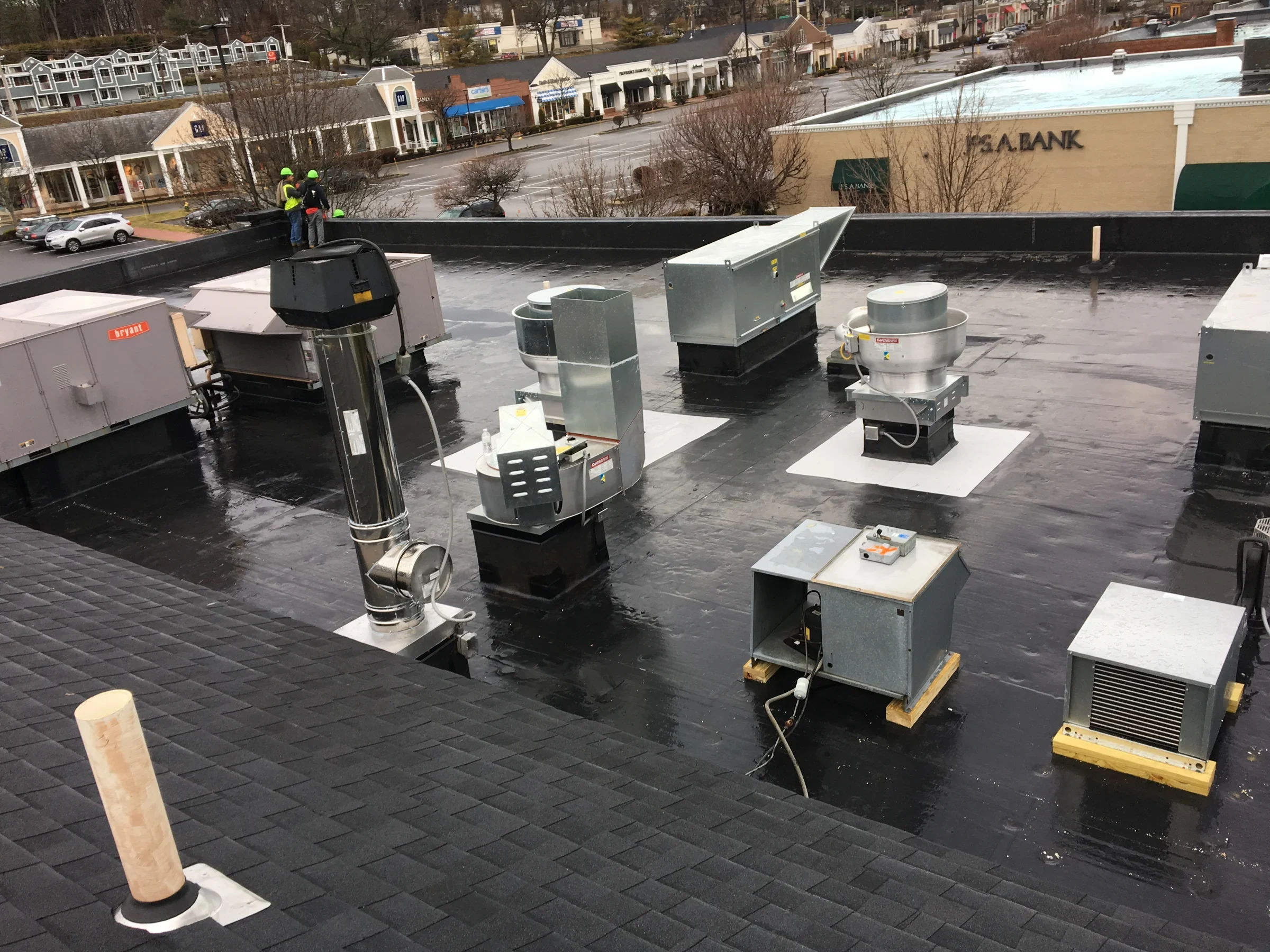
The large air-handling units that manage humidity and temperature across a gym's open floor plan are some of the hardest-working rooftop equipment we see on any commercial building type, and roof condition directly affects how efficiently those units perform. We map air handler locations and check surrounding membrane and flashing condition closely during inspections, since these units run near-constant duty cycles that put more wear on the surrounding roof area than standard HVAC equipment.
Insulation upgrades during a recover project on a gym roof tend to have a noticeable effect on how hard those air handlers have to work, particularly for facilities trying to manage the year-round humidity control a busy gym floor and locker room area demand.
Questions Gym and Fitness Center Owners Ask Us
Is condensation under our roof actually a leak, or something else?
Not always. We check vapor barrier integrity and insulation condition to distinguish true membrane leaks from condensation forming where humid gym air meets a cold roof deck.
Does our pool area need different roof treatment than the rest of the gym?
Yes, chlorine off-gassing and constant humidity over a pool area are more corrosive, so we use corrosion-resistant detailing and inspect that section separately.
Does insulation really matter more in a gym with high ceilings?
Yes, a larger open air volume takes more energy to heat and cool, so insulation performance across the roof field has an outsized effect compared to a low-ceiling retail space.
Can you work around our peak member traffic hours?
We coordinate with facility management on traffic patterns and avoid staging near entrances during the heaviest early-morning and after-work periods.
Do rooftop air handlers wear out the roof around them faster?
Often yes, since they run near-constant duty cycles managing gym humidity, so we check the surrounding membrane and flashing closely during inspections.